Reformation Day gives Christians an opportunity to look back and thank God for one of the most important events in church history. Every year on 31 October, believers remember how God used Martin Luther, John Calvin and other reformers to help bring His church back to the truth of His Word. Through what we now call the Great Reformation, God granted countless people to rediscover the life-changing message that salvation comes through faith in the crucified Jesus Christ alone and that His Word alone is the supreme authority in the church and in all we do. This article will focus mainly on how God used Luther, and the reason for our thankfulness.
A Church in Need of Reformation
During the Middle Ages, Christianity had spread across much of Europe. Missionaries faithfully carried the gospel to many regions and many people heard about Jesus for the first time. However, over the centuries, biblical truth became mixed with human traditions, superstitions and practices that were not founded on Scripture. Hence, most people lived in darkness.
The common people had little access to the Bible. Indeed, the dominating Roman Catholic Church with the pope at the head of a hierarchical church structure, kept the Bible in Latin and ensured that only the clergy could explain it to the people. Moreover, before the invention of the printing press, copies of Scripture had to be written by hand, making them rare and expensive. As a result, the church members depended entirely on church leaders for spiritual teaching and many of these church leaders were not well at home in God’s Word. Moreover, the way to salvation was administered through the seven sacraments, especially through the mass, and thereby presented the clergy as being indispensable for salvation.
Like the pharisees of old, the clergy were c considered themselves to be a cut above the rest of the people. And like the pharisees, they developed ideas and practices that distracted people from the message of God’s grace. They believed that religious objects, known as relics, had special spiritual power. They also taught that the people could partly earn salvation through their good works, such as caring for the poor and helping others.
The result was a generation of people who lived with uncertainty, wondering whether their good works outweighed their sins. Instead of enjoying the peace that comes from knowing Christ crucified as our complete Saviour, many constantly worried whether they had done enough to be accepted by God and to receive salvation.
Martin Luther’s Search for Peace
That’s the dark environment Martin Luther grew up in. As a young man, he was deeply concerned about his relationship with God. He feared God’s judgment and desperately wanted assurance that he would be saved.
Luther tried many things to find peace. Petrified during a thunderstorm, Luther promised to become a monk. He spent long hours in prayer, fasted, and disciplined himself severely. He even travelled on a pilgrimage to Rome, hoping this would bring him closer to God, but was shocked by the immoral behaviour and the corruption of the clergy there.
Nothing he did gave him the confidence he longed for. The harder he tried to earn God’s favour, the more aware he became of his own sinfulness. He lived in fear of God’s judgement.
What Luther needed was not more good works, but a deeper understanding of God’s grace.
Discovering the Truth of Scripture
God used Luther’s study of the Bible to transform his life. As a professor of theology at the University of Wittenberg, he spent many hours studying the books of the Bible as he prepared for his lectures. One on which he lectured was the book of Romans. There he encountered the powerful truth that changed everything: “The just [those who are righteous] shall live by faith” (Romans 1:17).
Luther also came to understand that sin is an inescapable reality within each person and that, no matter what we do, we can’t reflect or earn the righteousness God requires of us. He discovered that salvation is a gracious gift from God, received through faith in the sacrifice of Jesus Christ as the only atoning sacrifice. Christ has already done everything necessary to save sinners through His death and resurrection.
This discovery filled Luther with joy and peace. He later said that it was as though the doors of paradise had been opened to him, which in effect they were. The burden he had carried for so many years was lifted as he understood that forgiveness comes through Christ alone.
We, too, rejoice in this. And so, on Reformation Day, we remember God’s gracious opening of the believers’ eyes to Christ’s redeeming work and the wonderful comfort it gives to the reformed church. As Br Murray Plug [i] writes:
“On this Reformation Day we rejoice in the fact that Penance comes from the heart, and not from the purse! Our rejoicing is in the gift of grace which is priceless and cannot be purchased with bits of gold or silver.”
Today, as we reformed people look back, we may wonder at how people could have been so gullible. Br Plug writes:
“It seems to us to be a fairy-tale that people actually believed that money paved the way to heaven. We gently smile at the foolishness of a preacher in the town square bringing
‘glad tidings’ along with a big wooden chest; people tripping over each other to put in their gold and silver bits and walking away with a huge sense of relief because the tormented soul of a loved one is now at peace… And we tend to judge those people as being rather silly. Which they were, because they were duped into believing the lie.”
That lie was being proclaimed, in 1517, by a preacher named Johann Tetzel who travelled through Germany selling indulgences. These were documents that supposedly reduced punishment for sins and, according to some claims, could even help loved ones who had died get out of purgatory, a sort of cleansing or purification station souls went to before one could go to heaven.
Luther knew that these teachings conflicted with Scripture. There was no such place as purgatory and salvation could not be bought, sold, or earned by sinful people. It was a gift of God’s grace in Christ alone.
As Br Plug writes with allusions to Luther’s famous hymn:
“They were under the influence of the greatest fraudster who ever was. Listen to what Luther called him: the prince of darkness, ancient foe, crafty and powerful, armed with cruel hate. No one on earth was his equal!”
Br Plug gives this warning:
“It’s good for us and our children to remember that for our era. Let’s not kid ourselves… the greatest fraudster that ever was, still is. He wants us to believe that we don’t need the ‘Man of God’s choosing’ and in doing so he spreads lie upon lie about all sorts of things. He wants our children to be caught in the ways of the world characterised by things such as social comparison, envy, self-doubt, financial success.
He loves the preoccupation we and our children can have with social media, often resulting in chats which denigrate into gossip, slander and bad language. He wants our life’s goals to be about self and self-indulgence.
The fraudster knows that ‘we’ve got our doctrine right’. He also knows how challenging it is for us to align doctrine and life. However, as Luther put it: striving in own strength would be losing.
The Ninety-Five Theses
Wanting to encourage discussion about the selling of indulgences and other issues, Luther wrote a list of ninety-five statements known as the Ninety-Five Theses. We remember the Reformation on the 31st October because on that day in 1517 he posted the theses on the church door in Wittenberg.
God ensured that, what started as an academic challenge, quickly spread across Europe. Thanks to the recently invented printing press, copies were reproduced and shared widely. People everywhere became interested in the biblical truths Luther was teaching.
Standing Firm for the Gospel
Luther’s growing influence brought fierce opposition. The Roman Catholic Church authorities condemned his writings and ordered him to recant. However, Luther remained committed to the authority of Scripture.
At the famous Diet of Worms in 1521 he was asked to withdraw his teachings. Instead, he stood by what God’s Word taught, because it was the ultimate authority that even the pope had to abide by. He ended his speech with the famous words: “… I neither can nor will retract anything; for it cannot be either safe or honest for a Christian to speak against his conscience. Here I stand. I cannot do otherwise. God help me. Amen”.
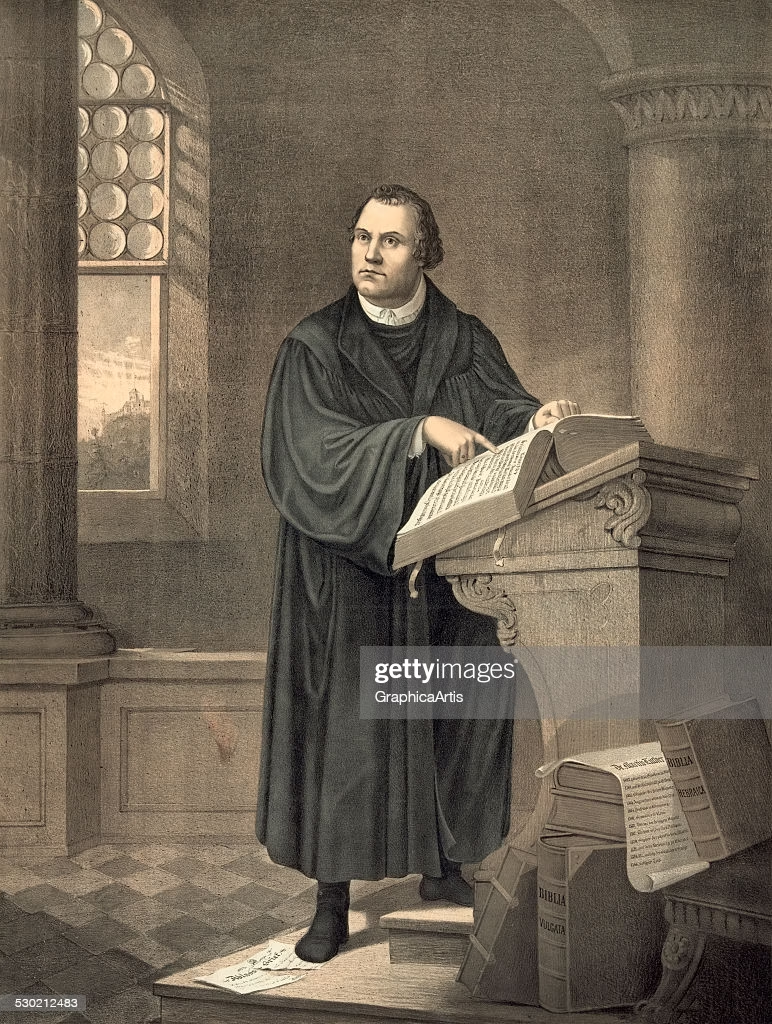
His courage inspired others to examine the Bible for themselves and to place God’s truth above human traditions.
The Great Truths of the Reformation
Several key teachings became central to the Reformation:
Scripture Alone (Sola Scriptura)
The Bible is the final authority for Christian faith and life. God’s Word, not human opinion or tradition, guides believers.
Grace Alone (Sola Gratia)
Salvation is a gift of God’s grace. We cannot earn it through our own efforts or achievements.
Faith Alone (Sola Fide)
People are justified before God through faith in Jesus Christ alone, not through good works or religious ceremonies.
The Reformers also emphasized that every believer has direct access to God through Christ, and the church is a community of people united by faith in Jesus.
Why Reformation Day Still Matters
More than 500 years later, Reformation Day reminds us of the importance of knowing God’s Word and trusting in Christ alone for salvation.
Christians today face different challenges from those Luther faced, but the central question remains the same: How can we be right with God?
The answer is not found in our achievements, popularity, religious activities or efforts to be “good enough”. The answer is found in Jesus Christ. Because of His perfect life, sacrificial death and victorious resurrection, sinners can be forgiven and welcomed into God’s family through faith.
The story of Martin Luther is ultimately not about one brave man. It is a story about God’s faithfulness. Through His Word, God brought light into spiritual darkness and renewed His church. Reformation Day encourages us to treasure that same Word and to rest in the wonderful truth that we are saved by grace alone, through faith alone, in Christ alone. Moreover, what Luther showed, and John Calvin more fully, is that not just the clergy but everyone—the tradie, the housewife, the office worker—is a priest in the service of God, called to live there where the Lord has placed him or her to the glory of God in thankful obedience to His commands.
Indeed, what the Lord started through Luther, He further established through John Calvin, whose prolific correspondence, tracts, treatises and books (e.g. Bible commentaries and Institutes of the Christian Religion) influenced people all over the world. So much of our church liturgy, Psalm singing, ecclesiastical documents and confessions have the work of Luther and Calvin as their starting point. Hence we may look back with much gratitude for what Christ—who gathers defends and preserves His church through the ages—gave us in the reformers and the Great Reformation of the 16th Century.
I end with a final quote from Br Murray Plug:
On this Reformation Day (and every day), let’s train our mind and eyes to look beyond ourselves to the one who has rescued us and continues to strengthen us in living for Him. He is none other than the ‘Man of God’s own choosing’, for His truth continues to abide, and His kingdom is forever.”
[i] Murray Plug (principal of the John Calvin Christian College, Armadale, Western Australia), “Reformation Day” in the college’s Weekly Times, 30 October 2026.