At the end of 2025 I wrote a letter to the editor of Una Sancta pointing to the recent focus on believers as being pilgrims. As examples I referred to the recent Women’s League Day which focussed on the need to have a ‘pilgrim mindset’, a mindset that sees this earth as not being our home but a place we’re passing through to a heavenly homeland. Rev. S. ‘t Hart, in a fine article “Sabbath Rest” in Una Sancta, said that, “Like Israel in the wilderness, we too are travellers, pilgrims, on the way to the Promised Land” (29/11/2025). And the Canadian Reformed Theological Seminary this month hosted a conference titled ‘Pressing On: Spiritual Care for Pilgrims’” where Mark Jones, author of The Pilgrim’s Regress, sought to help equip people “in this life’s hard pilgrimage on the way to everlasting glory”. I asked the EIC whether perhaps a minister would like to comment on this.
It reminded me of Rev. G van Rongen’s speech held back in 1976 which I summarised in Pilgrims? – Defence of the Truth. Subsequently, Rev. R. Schouten published an article about this subject titled “Not just passing through: rethinking the Pilgrim Concept” in Clarion Dec. 2025 which the EIC of Una Sancta kindly published 7 Feb. 2026. Rev. Schouten drew my attention to a speech held by Dr Jelle Faber about this matter in 1986. It is an encouragement to see the value of our labour, our cultural activity, on this earth. What follows is an abstract of Dr Faber’s speech by Rev. Schouten. [i]
JN
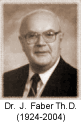
Man in Creation: Pilgrim or Prince?
In a time of renewed discussion concerning the cultural mandate and the relationship between Christianity and culture, it is good to review the approaches of various Reformed thinkers. One can begin by turning to the life and work of Abraham Kuyper (1837-1920), the Dutch stateman, theologian and church leader. The title of the late L. Praamsma’s recent book, Let Christ be King captures one of the central thrusts of Kuyper’s approach to culture, namely, the Kingship of Christ over all of life. As Kuyper said, “there is no inch or nook of all created life of which Christ the King does not say, ‘mine’”. Kuyper’s work was motivated, in part, by a desire to bring Reformed people into the mainstream of common grace. According to Kuyper, the beautiful things in cultural life can only be explained by common grace, a power which arrests sins and prevents the world from falling into worse sin, as well as serving the positive purpose of developing what God has placed in creation. Hence Christians can enjoy the fruits of common grace and enter into the mainstream of Dutch cultural life. Kuyper’s influence created a certain degree of cultural optimism among the Reformed people of his day.
The 1930’s saw the rise of a critical evaluation of Kuyper (K Schilder; S.G. DeGraaf et. al.) The criticism focused especially on Kuyper’s concept of “common grace”. Schilder was of the view that one should not use the word “grace” in a non-redemptive context. Despite his critique, however, Schilder also developed a positive cultural outlook, as is clear, e.g. in his book Christ and Culture. Schilder stresses the name Christ in his discussion of culture, because he wants to elaborate the office of the Saviour. He asks the question why Christ came into the world, and answers by saying that he came as the second Adam. From this he proceeds to a discussion of Adam’s task and office. Adam, says Schilder, was a fellow-worker with God (1 Cor. 3). Adam stood within creation and worked to bring it as a sacrifice of thanksgiving to God. Schilder’s definition of culture speaks of man’s work as bringing out the potential in creation. Man’s labour discloses and develops the possibilities inherent in creation. Man is God’s representative, his image-bearer in creation, and this image consists in exercising dominion. Upon his creation, man was given both a blessing and a command. God blessed man and said to him, “Be fruitful and multiply, and fill the earth and subdue it, and have dominion” … (Gen. 1:26). In chapter 3 one reads how man is placed in the garden for the purpose of “tilling” and “keeping” the garden. Schilder, therefore, would prefer to speak of mankind’s common mandate than of common grace. As the second Adam, Christ not only pays for the sins of the first Adam, but also restores man to his state of being God’s image-bearers. In a sense, the Lord Jesus is the first man, since he represented perfectly his Father in the world. In addition, the Lord Jesus always pointed man back to the original created situation as the norm for life. For instance, in his teachings on divorce, Christ responded to his interrogators by saying, “From the beginning it was not so”. Christ, as it were, brought the world back to its A. B. Cs.
Believers, then are being renewed to the image of God by an obedience to the will of Christ. Despite this renewal, however, believers can only expect fragmentary Christian cultural growth. The curse is restrained in the world, but believers nevertheless must respect the antithesis. Real culture, says Schilder, flourished only where the Church flourishes. The Church is the greatest cultural force in the world.
In his ethical writings, Dr J. Douma (Prof. of Ethics, Kampen) stresses Heb. 11: 13: “These all died in faith, not having received what was promised, but having seen it and greeted it from afar, and having acknowledged that they were strangers and exiles on earth”. Because of his stress on this verse, Douma develops a much more pessimistic view of the Christian’s place in culture and of the potential for developing a truly Christian culture. Christians are pilgrims, he says, and hence do not eat to work but work to eat. Douma does not think that texts such as Gen. 1:26, 2:15, 3:21, Ps. 8 give a mandate to man to develop creation. Instead of a mandate, he states, these texts speak only of a blessing upon man. Douma stresses that believers live in an interim period. The meaning of history in this interim is found in nothing but the preaching of the Gospel. The form of this world is passing away and so the main concern of the Church should be the preaching of the Gospel of salvation so that people might be saved.
Douma also disagrees with the optimism of Kuyper and Schilder as expressed in the idea that faithful culture-building in this period of history gives building stones for the new earth (Rev. 21). Douma again stresses the concept of being strangers. Let us work in order to eat and look forward to the day of Christ. The Christian should focus not so much on his cultural task as on the hope of the future, since he is on this earth as a pilgrim.

If one wishes to evaluate Douma’s view, this should begin with a close look at Heb. 11:13. The KJV rendering of this verse uses the phrase “strangers and pilgrims”. Via this verse and its use in, e.g., Bunyan’s Pilgrim’s Progress, the idea of “pilgrim” has had a tremendous impact. Bunyan’s character, “Christian”, is not in his homeland, but is on his way to heaven. This theme is also found in many Negro Spirituals (e.g. “This world is not my own, I’m just a-passin through.”)
The background to Heb. 11: 13 is to be found in Gen. 23:4. Abraham approaches the Hittites and says to them: “I am a stranger and a sojourner among you; give me property among you for a burying place, that I may bury my dead out of my sight.” If this is indeed the background, then the main idea of Heb. 11:13 is not that of pilgrimage, of a temporary passing through. Abram, was, after all, a prince, a “candidate-king”; he was to become the owner of Canaan. Abraham was, indeed, an heir of the world (Rom. 4). Although he was not yet in possession of the land (he had to buy a grave!) Abraham did already in his own day have a significant position in the land. He became a wealthy cattle-farmer in Canaan, and he even had a private army. As an heir, then, he built up a certain culture; he did not act as a pilgrim to whom the present world is of no concern at all except as a prelude to a future reality. It was indeed clear that this final destiny had not been reached, yet he had already received much as a gift. This inheritance which Abraham enjoyed already in his own day should not be spiritualized or allegorized. In the terms of Heb. 11:13, Christians should realize that as long as sin is in this world, and as long as they have not yet obtained the inheritance, they are indeed strangers and sojourners (not pilgrims). Nevertheless, believers look to the future when they shall receive the inheritance.
Some passages in the Bible seem to mitigate against this preliminary conclusion. Does not Revelation 18:4 clearly demand a separation between the believer and the culture of the world? Do not the words, “Come out of her my people, lest you take part in her sins, lest your share in her plagues”, clearly foster an attitude of pilgrimage? The answer is that the command, “Come out of her” refers not to the culture of the world, but to the false church.[ii] The believers are commanded to leave the false church.
John 18:37 reports Jesus’ words before Pilate: “My kingdom is not of this world”. Again, this verse should not be used to foster an other-worldly attitude. The meaning, rather, is that the kingdom of Christ does not arise out of this world. God sent his son to the world; salvation is based on intervention from without; it does not originate from within the world. It is clear from the theme of John that salvation has to do with this world: “For God so loved the world”.
In conclusion, therefore, the Christian should not operate in terms of a dualism between time and eternity. Eternity is spoken of in the Bible as “ages of ages”. There is an on-going history in eternity. Believers should recognize the continuity between life here and now and on the other side of death. This continuity finds expression especially in the Biblical description of the resurrection of the dead (I Cor. 15).
Believers should therefore have a clear understanding of their positive cultural task. Their lives on earth are not only a matter of avoiding the pitfalls and snares of worldly culture. Instead, they work in creation as God’s image-bearers. Their work is significant and will reverberate through eternity. Their works will follow them. The message of Ecclesiastes is that apart from the grace of God, life on earth is indeed a vain business. Knowing Christ, however, our labour is not in vain. As believers, we live in an awareness of our princely position, and we await the day when this position will come to full expression.
[i] Dr. J Faber spoke at the annual meeting of the Fellowship of Canadian Reformed University Students at Cambridge, Ontario, March 1986. Rev Rob Schouten’s abstract of the speech, based on notes made by I.H.A., appeared in In Holy Array (Vol. 33 No. 6, April 1986).
[ii] It seems to me (Jelte Numan) that J. Faber is following the line of Prof. B. Holwerda in “The Church in the Last Judgement” (https://spindleworks.com/library/holwerda/lastjudge.htm) in pointing to Babylon (Rev. 17 & 18) as the false church. K Schilder agrees but would broaden it to include worldly, God-denying culture (see “Schilder: Christ, the Key to Culture” in The Calvinistic Concept of Culture by Henry R. van Til).